
Solar for body corporates, sectional title complexes and estates in Cape Town
First Energy Solar Solutions
Complexes and estates carry electricity costs that individual owners never see on their own bills: lifts, gate motors, pumps, boreholes, common-area and security lighting, clubhouses, electric fences and bulk-metered supply losses. Those costs sit in the levy – and the levy rises every time the City’s tariff does. Solar on the common property is one of the few decisions trustees can take that lowers the levy instead of raising it.
Three ways a scheme can go solar
1. Common-property system (most schemes start here)
Panels and a hybrid inverter on the clubhouse, carports or a suitable roof, feeding the common-area supply. Cuts the bulk account, keeps gates, lifts and security running through outages, and can export excess to the City for credits.
2. Bulk system with allocation to units
For schemes on a bulk (check) meter with sub-metering, a larger system can supply units as well as common property, with savings allocated through the existing sub-metering. Requires the metering to be correct first – we assess this before quoting.
3. Per-unit systems under a scheme-wide agreement
Where owners want their own systems, trustees can adopt a single approved design, installer and aesthetic (panel colour, mounting, inverter position) and a standard exclusive-use or consent process. Owners buy individually; the scheme keeps control of the look and the compliance.
How schemes pay for it
- Reserve fund / special levy – lowest total cost; usually needs an ordinary or special resolution depending on the scheme’s rules.
- Rent-to-own – 3, 4 or 5-year plans from First Energy; the monthly payment is typically covered by the electricity saving so the levy does not move. The scheme owns the system at the end.
- Power Purchase Agreement (PPA) – for larger schemes we or a funding partner install and own the system and sell the scheme electricity at a rate below the City’s tariff, with no capital outlay. How PPAs work.
- Bank finance – we are an approved installer for Standard Bank Business Solar.
Compliance for schemes
- SSEG authorisation is required for any system in the City’s supply area; on a bulk supply the application is in the scheme’s name. We prepare and submit it.
- Insurance – the scheme’s building policy must be told about the installation; unregistered systems can prejudice claims.
- CoC for every DB the system touches.
- Engineering sign-off – our engineers design the system and MAC Engineers / BravoScan inspect the installation. Trustees get a documented, inspected asset – important when the trustees change.
- Managing agent packs – we provide the quote, drawings, savings model and resolution wording in a format that can go straight into the trustees’ pack or an AGM notice.
What trustees get from us
- A free desktop savings assessment from 12 months of the bulk account.
- An on-site engineering survey of roofs, DBs and metering.
- Two or three sized options (backup only / savings / savings + export) with payback for each.
- Funding options side by side.
- A presentation to trustees or the AGM if you want it.
Case study
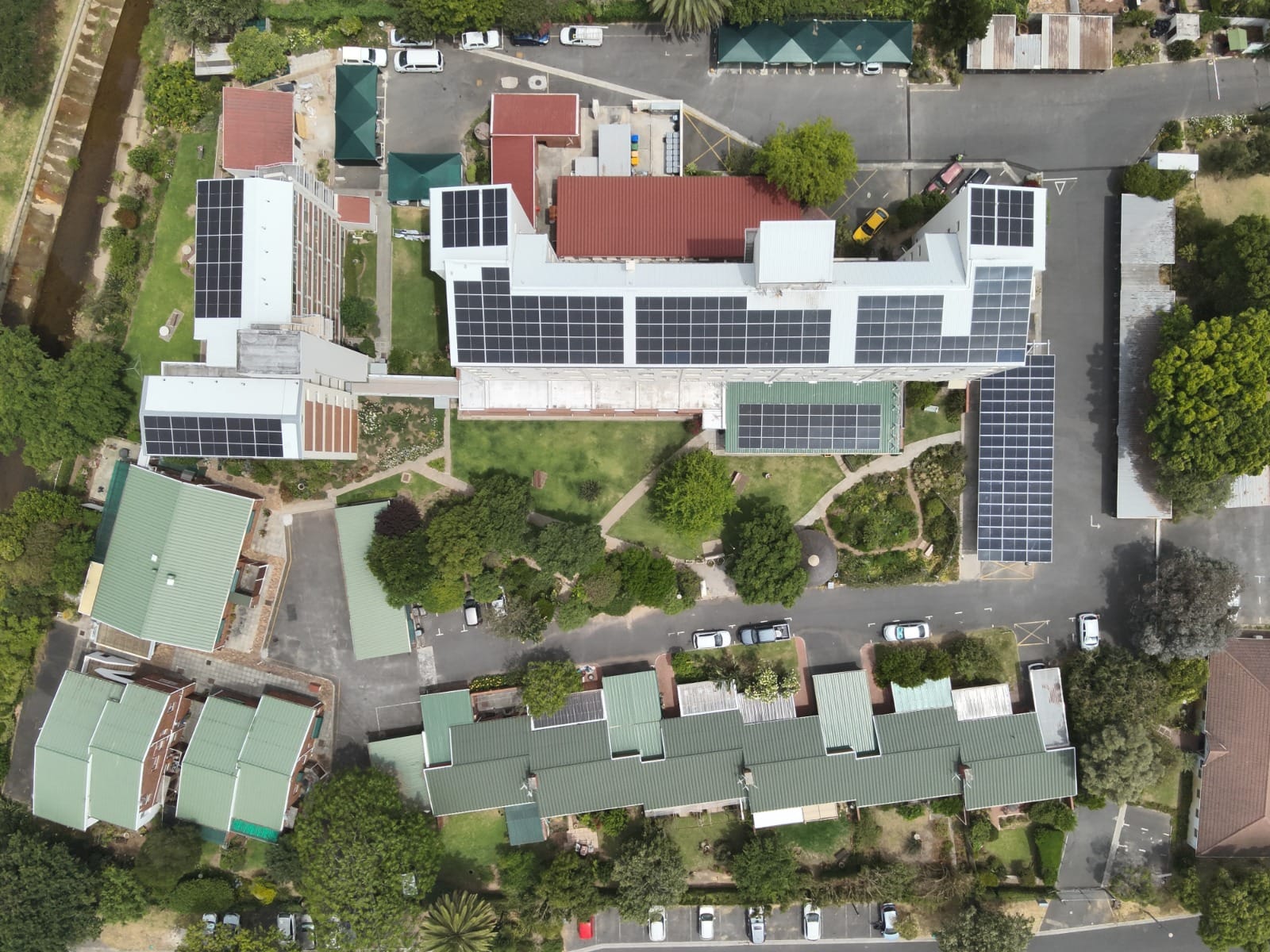
Rosebank, Cape Town – 100 kW grid-tied system. 230 glass-on-glass 620 W panels feed a single 100 kW three-phase grid-tied inverter. The system is designed to produce at least 241,279 kWh a year – worth about R713,000 of electricity in its first year at the City of Cape Town’s 2026/27 Small Power User 1 rate (257c/kWh excl. VAT, R2.96 incl. VAT), roughly R59,000 a month, and about R2.3 million over the first three years as tariffs rise 8–9% a year – and cuts the property’s carbon emissions by more than 99 tons a year. Designed by our engineers, registered with the City of Cape Town as a grid-tied SSEG installation and independently inspected on completion. See the project.
Savings assume the scheme uses the solar output on site; figures are indicative and exclude the fixed service charge, which solar does not remove.
Frequently asked questions
Does the whole scheme need to agree?
It depends on the scheme’s rules and whether common property is altered. Most common-area systems are treated as a maintenance/improvement decision; larger projects and PPAs usually need a resolution. Your managing agent will confirm; we supply the wording.
Can individual owners still install their own systems?
Yes, subject to the scheme’s rules and consent process. Many schemes adopt a standard design so all installations look the same.
What happens in a power outage?
With a battery, the common-area supply (gates, lifts, lights, security) keeps running. We size the battery for the loads the scheme must keep on.

Contact us if you have any questions.
SARS FAQ on the 2023–2025 enhanced incentive (now expired) – Learn more.